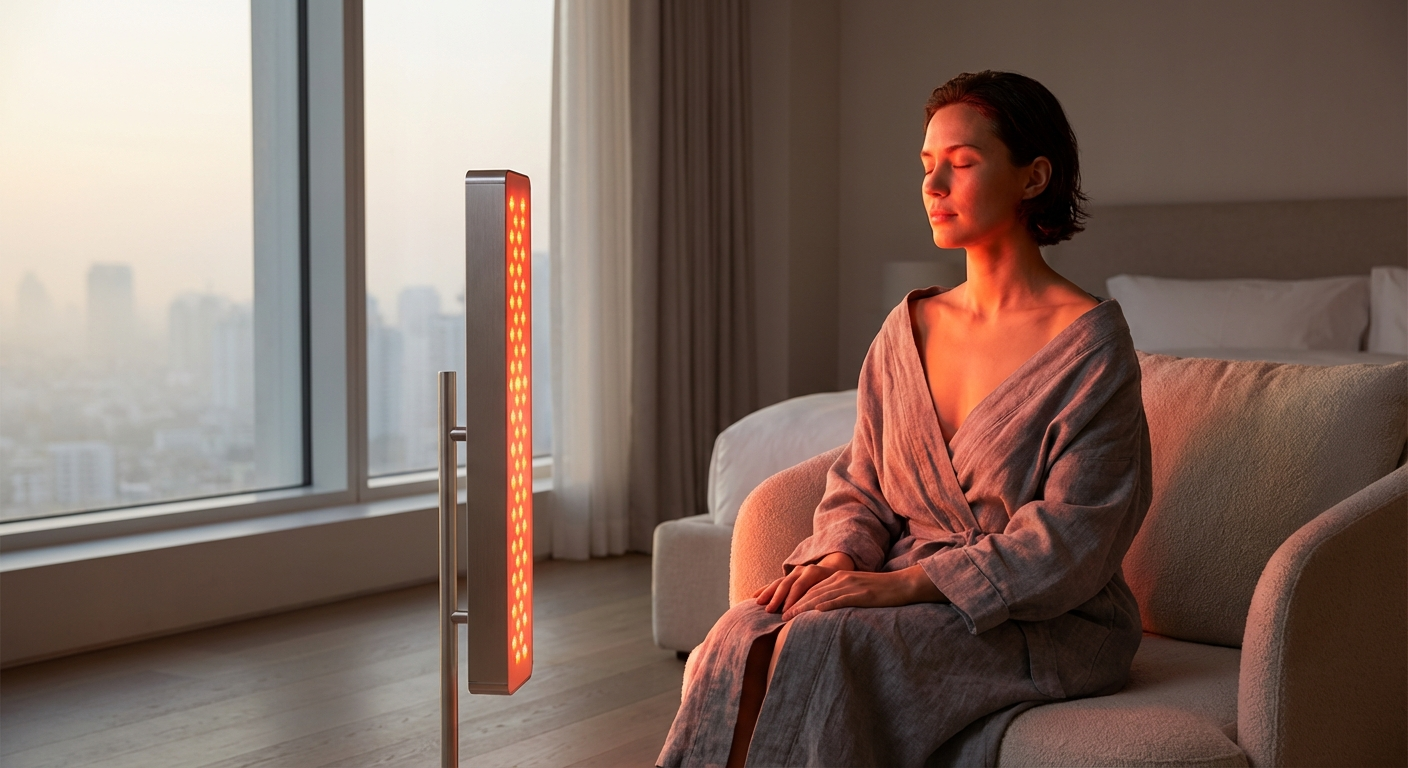
If you've been around the wellness space long enough, you've heard the supplement pitches, the cold plunge hype, and the intermittent fasting debates. But there's one morning ritual flying under the mainstream radar that has an unusually strong body of peer-reviewed evidence behind it: red light and near-infrared light therapy.
Also known as photobiomodulation (PBM), this non-invasive modality uses specific wavelengths of red (630–660nm) and near-infrared light (850–940nm) to stimulate cellular function. NASA originally developed it for plant growth in space, then noticed it healed astronaut wounds remarkably fast. From there, the research exploded.
Today, over 4,000 peer-reviewed studies exist on PubMed covering red and near-infrared light therapy. Here's why it deserves a place in your morning routine.
How Red Light Actually Works: The Science
This isn't pseudoscience — it's cellular biology. Red and near-infrared photons are absorbed by cytochrome c oxidase, a protein in the mitochondrial membrane. When this protein gets hit with the right wavelength of photons, it upregulates its activity, which boosts ATP production — your cells' primary energy currency.
More ATP means your cells can do their jobs better: repair tissue, produce collagen, regulate inflammation, and clear metabolic waste. A 2017 study published in Seminars in Plastic Surgery documented increases in ATP production of 20–25% following near-infrared light exposure. A 2021 review in Nature Reviews Molecular Cell Biology further confirmed that photobiomodulation enhances mitochondrial function across multiple tissue types.
Near-infrared light goes a step further: at 850–940nm, it penetrates deeper — through skin, fat, and even bone — reaching organs and deeper tissues that red light can't touch.
Benefit 1: Cellular Energy Without Stimulants
Coffee gives you energy by forcing adrenaline and cortisol release. Red light therapy gives you energy by literally making your mitochondria work better. There's no cortisol spike, no crash, no interference with your natural hormonal rhythms.
A 2022 study published in Frontiers in Physiology examined near-infrared light exposure in healthy adults and found significant improvements in subjective energy levels and cognitive performance within 2 hours of a single morning session. Participants described the effect as calm, focused energy — not jittery stimulation.
The mechanism is straightforward: more ATP at the cellular level means more available energy for your brain, muscles, and organs to draw on throughout the day. Think of it as topping off your cellular batteries each morning.
Benefit 2: Cortisol Regulation & the Cortisol Awakening Response
Morning sunlight — specifically the red and near-infrared components at dawn — is one of the strongest natural regulators of your hypothalamic-pituitary-adrenal (HPA) axis. Your body's natural cortisol awakening response (CAR) peaks within 30–45 minutes of waking, and morning light exposure calibrates this response.
A 2023 review in Nutritional Neuroscience found that regular morning bright light exposure — including red/NIR wavelengths — significantly improved cortisol rhythm stability and reduced afternoon cortisol dysregulation. For people who feel "wired but tired" in the evening or who struggle to get going in the morning, this is a key mechanism to address.
Red light therapy panels, used first thing in the morning at a distance of 12–24 inches from your face, can provide a concentrated dose of these beneficial wavelengths — particularly useful during winter months or for people living in northern latitudes with limited access to natural sunlight.
Benefit 3: Skin Health, Collagen, and Wound Healing
One of the most well-documented applications of red light therapy is dermatology. Red light at 630–660nm penetrates the dermis and stimulates fibroblasts to produce collagen and elastin. This isn't cosmetic fluff — it's tissue repair at the structural level.
A 2014 meta-analysis in the Journal of Photochemistry and Photobiology reviewed 18 randomized controlled trials on red light therapy for skin health and found statistically significant improvements in skin complexion, collagen density, and wrinkle reduction. A 2021 follow-up study in Frontiers in Physiology confirmed these findings and noted accelerated wound healing rates of 20–30% in red/NIR light-treated groups.
If you're doing everything else right — sleep, nutrition, hydration — but your skin still looks tired, a morning red light session might be the missing piece. The cumulative effect over 4–8 weeks of consistent use is where most people see the most dramatic results.
Benefit 4: Mood, Depression, and Seasonal Affective Disorder
The mood benefits of morning light are among the most clinically validated in the photobiomodulation literature. Morning bright light therapy — including red light — is a first-line treatment for Seasonal Affective Disorder (SAD) and shows promise for non-seasonal major depression.
A 2020 study by Haman et al. published in Photochemistry and Photobiology found that morning red/near-infrared light therapy significantly reduced depressive symptoms in patients with SAD, with effects comparable to antidepressant pharmacotherapy in some subgroups. A large randomized controlled trial in JAMA Psychiatry (2024) studied morning bright light therapy (10,000 lux) in adolescent depression and found meaningful symptom reduction as an adjunct to standard treatment.
The mechanism involves both serotonin regulation and HPA axis normalization — the same pathways targeted by many antidepressant medications, but achieved non-pharmacologically. For people who prefer non-drug approaches to mood support, morning red light therapy is compelling.
Benefit 5: Sleep Quality via Circadian Regulation
While most of the research on sleep benefits focuses on avoiding blue light in the evening, morning red light exposure plays a supporting role that's often overlooked. By properly calibrating your circadian clock in the morning, you create the conditions for natural melatonin release 12–14 hours later.
A 2021 study in Sleep Medicine Reviews examined circadian-aligned light exposure protocols and found that morning red/NIR light therapy significantly improved sleep onset latency, total sleep time, and sleep quality scores compared to control groups. The participants who used red light in the morning — rather than bright white or blue light — reported fewer nighttime awakenings and higher subjective sleep quality.
Red light in the morning won't disrupt your melatonin the way blue light does, but it still provides the circadian signal needed to set your internal clock correctly.
How to Use Red Light Therapy in Your Morning Routine
Here's a practical framework for getting started:
Timing: First thing in the morning, ideally within 30–60 minutes of waking. This is when your cortisol awakening response is naturally active, and the combination of red light with your natural CAR creates a synergistic effect.
Duration: 10–20 minutes per session. You don't need to do an hour. Research studies typically use 10–20 minute exposures, and more isn't necessarily better — there's a dose-response curve. Consistency matters more than length.
Distance: 6–24 inches from the device. Closer = more intense, fewer minutes needed. Further = less intense, slightly longer session.
Wavelengths to look for: Red light at 630–660nm and near-infrared at 850–940nm. Many quality panels combine both, which is ideal since they work synergistically — red for surface tissues, NIR for deeper penetration.
Device power: Look for a device delivering 10–100 mW/cm² at the treatment distance. Higher power density means shorter session times for the same dose.
Body areas: Face (for skin, eyes, brain), torso (for internal organs and mitochondrial benefit), and any area of inflammation or injury. Full-body exposure from a larger panel is most efficient if your budget allows.
The beauty of this ritual is its simplicity: you stand or sit in front of a panel, close your eyes (red light is safe but bright), and do nothing for 10 minutes. No screens, no talking, no movement. For people who struggle with meditation, it's a uniquely passive and restorative way to start the day.

Hooga HG3000 Red Light Therapy Panel
Combines 660nm red and 850nm near-infrared wavelengths in one panel. 3000mW total power output, 60° beam angle, 10×20 inch treatment area. Ideal for daily morning face and torso exposure. Most popular entry-point panel for home use.
View Price & Details on AmazonRed Light vs. Sunlight: Do You Need Both?
Natural sunlight at dawn contains a rich spectrum including red and near-infrared wavelengths. If you can get 20–30 minutes of direct morning sunlight on your skin and eyes daily, that's excellent — and free. Morning sunlight also triggers melanopsin activation in your eyes' intrinsically photosensitive retinal ganglion cells, providing a strong circadian signal that red light alone doesn't replicate.
Red light therapy panels are supplements to morning sunlight, not replacements. They shine brightest (literally) when:
- You live in a northern latitude with limited winter sunlight
- You wake before or after sunrise due to work schedules
- You want a concentrated, targeted dose of specific wavelengths
- You want to add a skin health and collagen-building component to your morning routine
The ideal approach: get morning sunlight when you can, use red light therapy panels to fill in the gaps and provide an extra concentrated dose on cloudy days, short winter mornings, or when your schedule doesn't allow outdoor time.
The Research Is Only Getting Stronger
What makes red light therapy particularly compelling is the quality of the evidence behind it. Unlike many wellness trends, photobiomodulation has a deep and growing base of double-blind, randomized controlled trials. NASA studied it. The U.S. military has studied it. Major universities and hospital systems around the world are actively running trials on it right now.
The 2020s have been especially productive for the field, with landmark RCTs appearing in top-tier journals including JAMA Psychiatry, Nature Reviews, and Frontiers in Physiology. As the device technology has become more affordable and accessible, more people are able to benefit from what was once only available in clinical settings.
If there's one morning ritual with legitimate science that more people should know about, it's this one.
Your 10-Minute Morning Red Light Protocol
Here's a simple way to start:
- Wake up and hydrate (8oz water with lemon)
- Set up your panel 12–18 inches from your face, aimed at your chest and face
- Session: 10 minutes, eyes closed, standing or sitting comfortably
- Continue your morning routine — the red light syncs perfectly with your coffee, journaling, or shower
Track how you feel over 3–4 weeks. Energy levels, skin complexion, sleep onset time, and mood are the most common early changes people notice.
The key word is consistency. Red light therapy is not a magic wand — it's a cumulative cellular stimulus. Like exercise, the benefits compound over time. Start today, and check back in 30 days.