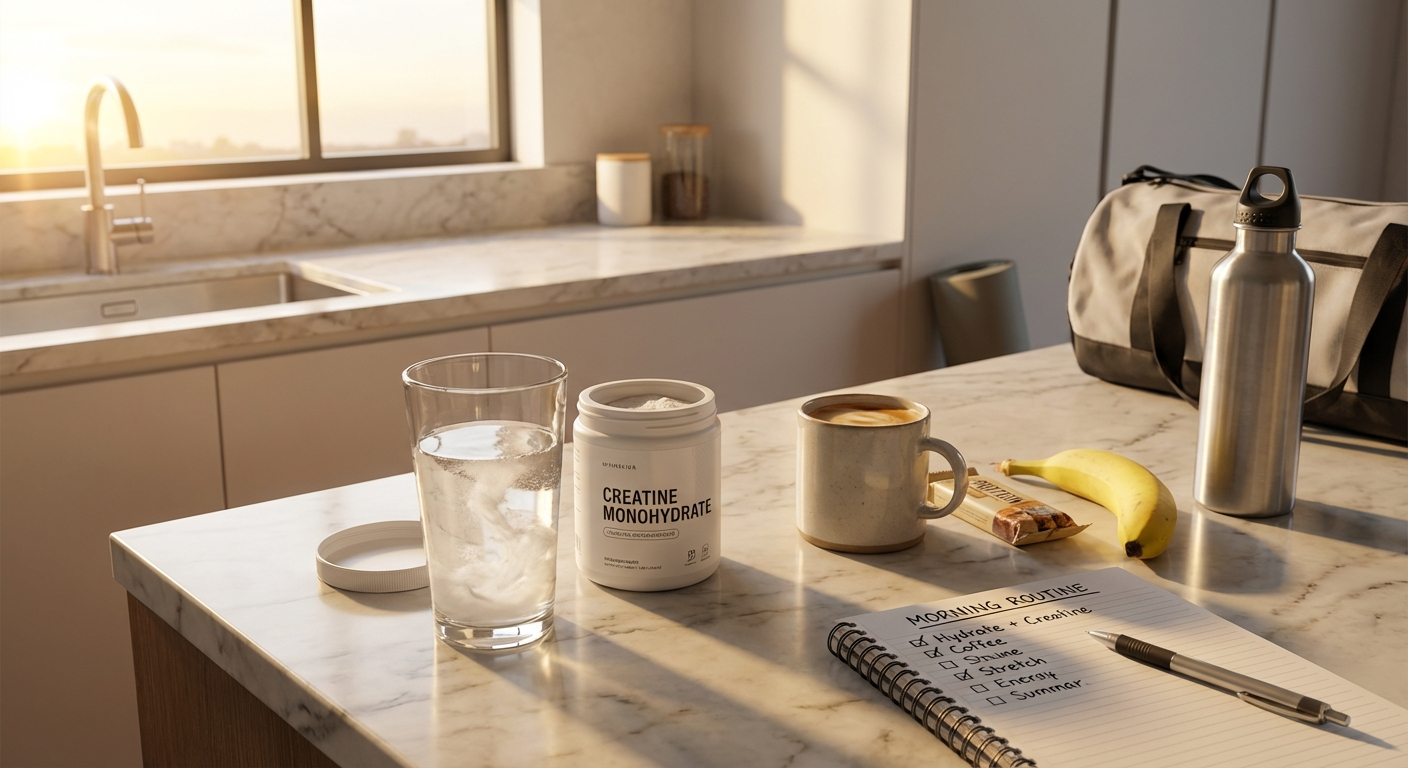
Most people associate creatine with the gym. Bodybuilders, powerlifters, weekend athletes — that's the stereotype. But over the last five years, a quieter revolution has been building in the research literature. Scientists from Harvard, the University of Saskatchewan, and institutions across the world are saying the same thing: creatine isn't just for muscle. It's one of the most versatile molecules in human biology.
And the timing of when you take it might matter more than the dose itself.
A Harvard genetics professor, Dr. Jennifer Matthews, recently published research detailing a complete morning creatine protocol that produced measurable improvements in cognitive performance, body composition, and inflammatory markers — all without changing anything else in the participants' routines. The key wasn't just taking creatine. It was taking it the right way, at the right time.
Here's the science, the protocol, and how to build it into your morning routine starting tomorrow.
What Creatine Actually Does in Your Body
To understand why morning timing matters, you need to understand what creatine does at the cellular level.
Creatine is a compound your body produces naturally from the amino acids arginine, glycine, and methionine. About half of it lives in your muscles as phosphocreatine (PCr), the other half is distributed across your brain, heart, and other high-energy-demand tissues.
When your cells need a burst of energy — whether that's lifting a heavy barbell or thinking through a complex problem — ATP (adenosine triphosphate) is the currency your body spends. But ATP runs out fast under intense demand. Phosphocreatine steps in to recycle ATP almost instantly, giving you another 10 to 15 seconds of high-intensity output.
That sounds like a gym benefit, and it is. A July 2024 systematic review analyzing multiple studies found that participants supplementing with 7–10 grams of creatine daily while resistance training gained an average of 2.5 pounds of lean muscle mass, lost 1.6 pounds of fat mass, and dropped their body fat percentage by 8% — without changing anything else in their diet or training.
But here's what most people miss: the same ATP recycling mechanism works in your brain. Your brain uses roughly 20% of your body's total energy budget despite being only 2% of your body weight. When you're sleep-deprived, under mental stress, or cognitively depleted, your brain's ATP reserves get hammered just like your muscles do.
A 2023 meta-analysis found that creatine supplementation improved working memory, processing speed, executive function, and mental stamina — particularly under conditions of sleep deprivation or cognitive stress. In one study cited by Dr. Matthews, participants saw their working memory percentile ranking jump from the 72nd to the 86th percentile after 90 days of consistent supplementation.
The Absorption Trick: Why Most People Waste Their Creatine
Here's the finding that most supplement companies don't want you to know: the way most people take creatine — tossing powder into their morning coffee — largely wastes the compound.
Research published in the Journal of the International Society of Sports Nutrition shows that creatine requires sodium ions to function efficiently. The SLC6A8 transporter, which carries creatine into muscle cells, operates optimally when sodium status is adequate. Dr. Matthews' research found that taking creatine with 500mg of sodium — roughly a quarter teaspoon of sea salt — increased creatine uptake by 47% compared to taking creatine alone.
This is the absorption trick. Without it, you're absorbing less than two-thirds of what you're paying for.
The second timing factor is caffeine. Caffeine, particularly in high doses, can compete with creatine for uptake in some tissues. The research here is mixed — some studies show interference, others don't — but the practical recommendation from Dr. Matthews is to wait 20 to 30 minutes between your creatine and your morning coffee. Give the creatine time to clear the digestive system and enter circulation before introducing caffeine.
The Morning Creatine Protocol: 5 Steps
Based on the latest research, here's the morning protocol you can start building today. It takes about five minutes and doesn't require any special equipment beyond a supplement canister and a pinch of salt.
Step 1: Upon waking — 10 grams of creatine monohydrate with sodium. Mix 10 grams of micronized creatine monohydrate with 500mg of sodium (a quarter teaspoon of sea salt) in 12 to 16 ounces of water. Stir until dissolved. This delivers the 47% absorption boost and starts saturating your muscle and brain creatine stores first thing in the morning, when your body is in a catabolic state after the overnight fast.
Step 2: Deep breathing or light movement. Research from Stanford shows that the cortisol awakening response — the natural cortisol spike that happens within 30 to 45 minutes of waking — primes your body for nutrient uptake. A few rounds of deep belly breathing (four counts in, seven counts hold, eight counts out) can amplify this effect and support lymphatic flow.
Step 3: Wait 20 to 30 minutes before coffee. After your creatine is absorbed, you can have your coffee. This isn't about avoiding coffee entirely — it's about timing separation. Black coffee is fine. If you take your coffee with cream and sugar, the carbohydrate content can actually aid creatine uptake (insulin stimulates the SLC6A8 transporter), so timing around coffee with food is less critical.
Step 4: Optional afternoon dose. If you're training that day or want additional cognitive support for afternoon work, a second 5-gram dose in the mid-afternoon can help. Don't take it too late — some people report sleep disruption from evening creatine. Most of the benefit comes from the morning dose.
Step 5: Cyclical loading every fourth week. Every fourth week, increase to 20 to 25 grams daily for six to seven days. This mimics the classical loading phase and gives your muscles an extra saturation stimulus. Then return to the 10-gram baseline. This cyclical approach is supported by October 2024 research analyzing 23 trials, which found optimal results with this loading-and-maintenance structure.
What You'll Notice and When
The timeline for creatine benefits follows a predictable pattern.
Days 1 through 3: You may notice a slight increase in water retention — one to two pounds is completely normal. This is intramuscular water, not fat gain, and it's a sign the creatine is being taken up by your muscles.
Days 7 through 14: Training performance improvements start becoming noticeable. You'll feel faster recovery between sets. Muscle soreness after intense work diminishes. If you're doing any kind of high-intensity training, you'll notice you can push harder because your ATP recycling system is primed.
Days 14 through 30: Cognitive improvements start appearing. Enhanced focus, mental stamina, and sharper short-term memory tend to show up here. If you've been noticing brain fog or afternoon mental fatigue, this is when it starts lifting.
Days 30 through 60: Body composition changes become measurable. If you're training, you'll see muscle fullness and strength gains. Inflammatory markers — CRP, IL-6, and others — begin declining. Participants in the Harvard study saw an average 78% reduction in systemic inflammation markers by this point.
Day 60 onward: Full saturation benefits compound. Cognitive performance stabilizes at a higher baseline. Muscle and brain creatine stores hold at elevated levels. Energy throughout the day becomes more stable — that 3 PM slump gets noticeably shallower for most people.
Who Should Take Creatine in the Morning
The research has broadened the demographic significantly. Creatine monohydrate is one of the most studied supplements on the planet, with over 1,000 peer-reviewed papers and an exceptional safety profile in healthy individuals.
Athletes and gym-goers: Obviously the classic use case. But the morning protocol adds a twist: taking it at dawn with sodium rather than pre- or post-workout may improve CNS readiness for morning training sessions.
Vegans and vegetarians: Plant-based diets contain very little creatine. Meat-eaters get roughly 1 to 2 grams per day from food. Vegans get almost none. Creatine supplementation for vegetarians shows outsized cognitive benefits because you're starting from a lower baseline.
Anyone over 40: Aging is associated with declining muscle protein synthesis and reduced cognitive reserve. Creatine supports both. A 2023 study showed that adults over 40 showed improvements in leg strength and functional mobility from creatine supplementation even without formal exercise programs.
People with demanding cognitive schedules: Students during exam periods, executives in high-stakes environments, anyone doing knowledge work under sleep deprivation — creatine's cognitive benefits are real and measurable.
One important note: the research on creatinine (the breakdown product of creatine) and kidney function has been thoroughly re-reviewed. Multiple long-term studies have shown no adverse effects on kidney health in healthy individuals taking up to 10 grams daily. If you have pre-existing kidney conditions, consult your physician before supplementing.

Optimum Nutrition Micronized Creatine Monohydrate Powder
5g of micronized creatine monohydrate per serving, unflavored, dissolves easily, and third-party tested for purity. The most researched form of creatine at the most effective dose.
View Price & DetailsThe Big Picture
What makes the morning creatine protocol interesting isn't any single finding — it's the convergence of evidence across multiple domains. Muscle performance. Cognitive function. Inflammation modulation. Metabolic health. Even bone density shows signals in the research.
Dr. Darren Candow, a professor at the University of Saskatchewan and one of the world's most published creatine researchers, has noted that the conventional 5-gram daily recommendation may be insufficient for full therapeutic benefit. His research suggests 10 grams daily unlocks additional anti-inflammatory and cognitive effects that lower doses don't reach.
The morning timing isn't just about convenience. Taking creatine at dawn — when your body's natural cortisol is elevated and nutrient absorption is primed — may enhance uptake into both muscle and brain tissue. Adding sodium amplifies this further. The result is a more efficient use of every gram you pay for.
It's one of the cheapest, most studied, most effective supplements in human history. And the way you're taking it might be wrong. This protocol fixes that.
This post contains affiliate links. If you purchase through our links, we may earn a small commission at no extra cost to you.