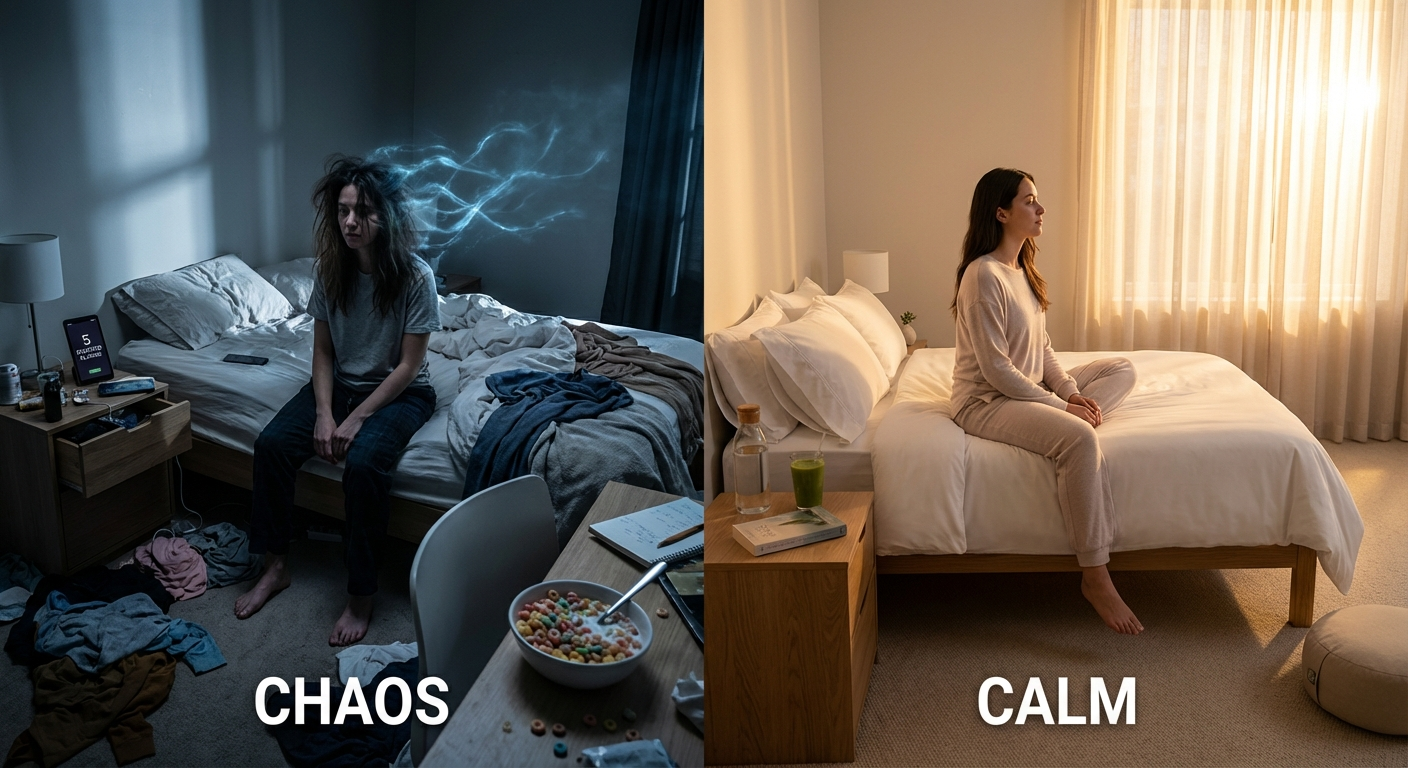
You wake up at 6:14 AM. Your alarm has been snoozed three times. You scroll your phone for fifteen minutes before your feet even touch the floor. By the time you're standing, you've already burned through a meaningful chunk of your morning willpower — before you've made a single real decision.
Sound familiar?
Here's the uncomfortable truth that behavioral science has been screaming for decades: willpower is not a virtue. It's a finite resource that depletes with every decision you make. And your environment — the physical space you wake up in, the objects within reach, the default options surrounding you — is either quietly draining that resource or protecting it.
The good news? Once you understand how environment design works, you can set up your mornings so that the healthy choice is also the easy choice. No motivation required. Noheroic acts of discipline needed.
The Ego Depletion Crisis: What Science Actually Says
In 1998, social psychologist Roy Baumeister ran a series of experiments that would change how we think about self-control. His team found that people who had to resist donuts and freshly baked cookies — then later faced a demanding cognitive task — performed significantly worse than those who hadn't had to exercise restraint at all.
The effect was dubbed ego depletion: the idea that self-control draws from a limited daily reservoir. Subsequent research by Baumeister and others has refined this picture. A 2021 meta-analysis in the British Journal of Social Psychology reviewing 140+ studies confirmed that ego depletion effects are robust across domains — decision-making, emotional regulation, pain tolerance, and cognitive performance all suffer when willpower is taxed early.
What does this mean for your morning?
Every friction-laden choice you face in the first hour — Should I work out or sleep? Should I make breakfast or grab fast food? Should I respond to that email or ignore it? — draws down your reservoir. The average person makes approximately 35,000 decisions per day, with morning hours carrying disproportionate weight because everything feels high-stakes before your day has found its rhythm.
But here's what the productivity industry doesn't tell you: you can't willpower your way to a better morning. You have to architect it.
The 4 Forces That Shape Your Morning (Before You Open Your Eyes)
Behavior scientist Wendy Wood, whose work at the University of Southern California has become foundational in habit research, spent decades studying why people do what they do. Her conclusion: up to 43% of daily actions are actually habits — automatic behaviors triggered by environmental cues, not deliberate choices.
Your morning environment is a trigger system. Four forces govern every action you take before 9 AM:
1. Friction vs. Fluency
The harder something is to do, the less likely you'll do it. Conversely, the easier something is, the more it becomes your default. This is Newton's First Law of Behavior: objects in motion stay in motion, objects at rest stay at rest — unless force is applied.
In practice: leaving your workout clothes next to your bed makes exercise more likely. Placing your phone across the room instead of on your nightstand eliminates the reflexive scroll. Pre-making your breakfast means you won't default to skipping it.
2. Default Options
Richard Thaler and Cass Sunstein, in their groundbreaking work on nudge theory, demonstrated that default options are extraordinarily powerful. In organ donation systems where opting-out is the default, participation hits 90%+. In savings plans where enrollment is automatic, retirement savings rates soar.
In your morning: if healthy food is the default option in your kitchen — already prepared, already visible — you'll eat it without deliberation. If your morning routine is pre-designed with specific time blocks, you follow it without deciding.
3. Prime & Cue Architecture
Your environment primes your behavior before you're consciously aware of it. A kitchen with fresh fruit on the counter and chips hidden in a pantry produces different eating behaviors in the same person. A bedroom with books visible on the nightstand produces more reading than one where the TV remote is the most accessible object.
The cue has to come before the craving. In habit loop terminology: Cue → Craving → Response → Reward. If your cue is a pile of unwashed dishes, your craving for order produces the response of stress. If your cue is a ready-to-use French press with beans pre-measured, your craving for caffeine produces the response of a satisfying morning coffee ritual.
4. Pre-Commitment Devices
This is the nuclear option for willpower optimization. Pre-commitment means making a future decision binding in the present — removing your own ability to deviate. Alcoholics Anonymous uses this principle: you publicly commit to sobriety, making the social cost of breaking that commitment greater than the cost of staying sober.
In morning routines: telling a friend you'll send them a workout selfie at 7 AM creates social accountability. Paying for a gym membership upfront makes skipping feel expensive. Pre-loading your blender with ingredients the night before removes the "I don't want to prepare it" barrier.
The Morning Environment Audit: 7 Changes That Actually Work
Knowing the science is one thing. Redesigning your space is another. Here's a practical framework — no renovation required.
🔌 The Nightstand Reset
Your nightstand is the first environment you interact with every morning. If your phone is charging within arm's reach, you're almost certainly starting your day with reactive scrolling instead of proactive intention-setting.
The fix: Charge your phone across the room, or use an alarm clock. Keep your nightstand stocked with tools that support your morning goals: a full water bottle, a notebook for journaling or planning, and a book (paperback, not e-reader — research shows screen exposure before bed suppresses melatonin and clouds morning cognition).
☕ The Automatic Morning Ritual
Every decision in your morning routine costs you. "Should I have coffee or tea?" "Should I stretch first or shower first?" "Should I eat before or after exercise?" When these decisions are pre-made, your morning runs on autopilot — which is exactly what you want.
The fix: Automate the sequence. Use an automatic coffee maker with a timer. Pre-prep your gym bag. Plan your breakfast the night before. Design a template routine that runs the same order every day so the sequence itself becomes the habit, not a series of individual decisions.
📵 The Phone Boundary
Gloria Mark at UC Irvine has studied digital attention for over two decades. Her research found that after checking email or social media in the morning, people took an average of 23 minutes to return to focused work. That's nearly half an hour of fragmented, cognitively impaired productivity — every single day.
The fix: No phone for the first 60–90 minutes after waking. Use a physical alarm clock. Keep your phone in another room or in a drawer until your morning non-negotiables (movement, hydration, nutrition) are complete.
🌅 Light Exposure Timing
Your circadian system is cued primarily by light, specifically short-wavelength (blue) light in the morning. Andrew Huberman's neuroscience lab at Stanford recommends 10–30 minutes of bright outdoor light (or an equivalent 10,000 lux light panel) within 30–60 minutes of waking to set your circadian clock andboost alertness for hours.
The fix: Open your blinds before you do anything else. Step outside briefly. If you wake before sunrise, consider a light therapy lamp on your nightstand — point it at your face while you're making your bed or brushing your teeth.
🍽️ The Pre-Prepped Kitchen
When hunger meets an unprepared kitchen, defaults kick in: fast food, vending machines, skipped meals. Each of these has cascading metabolic and cognitive effects that carry into late morning.
The fix: Prepare your breakfast the night before. Overnight oats, a pre-blended smoothie pack, or even just setting out the bowl and spoon reduces the friction to zero. Your future morning self will thank you.
🧠 The 2-Minute Rule for Mental Clarity
If a task takes less than two minutes, do it immediately. This principle from David Allen's Getting Things Done methodology eliminates the micro-decisions that compound throughout the morning. Making your bed takes two minutes. Loading one dish takes two minutes. Responding to a non-urgent text takes two minutes.
By clearing these micro-tasks immediately, you prevent what I call decision backlog — where a stack of small unresolved items creates ambient cognitive load that slows everything down.
📋 The Night Brief
The most effective environment design happens the night before. Before bed, spend 90 seconds writing down your three morning priorities. This externalizes the decision-making to a time when you're not depleted, so your morning self just has to execute rather than deliberate.
This works because of how memory consolidation operates: your brain processes and organizes information during sleep, effectively "pre-loading" the decisions you've already made. The night brief creates a roadmap your rested self can follow without resistance.
The Real Cost of an Unstructured Morning
Most people underestimate how much a chaotic morning costs them. It's not just the 20 minutes of lost productivity — it's the cognitive tax that carries forward. Decision fatigue compounds. Each suboptimal choice makes the next one harder. By noon, you're running on fumes, wondering why you're so tired despite not doing anything "strenuous."
The people who seem to have exceptional discipline aren't actually stronger-willed. They've simply designed their environments so discipline is rarely needed. Their morning architecture does the heavy lifting.
James Clear, author of Atomic Habits, puts it this way: "Every habit is the outcome of a system. You don't rise to the level of your goals; you fall to the level of your systems." Your morning environment is your most leverageable system — because it's the one that sets the tone for everything that follows.
The goal isn't to become a morning robot running a rigid script. It's to remove the resistance between your intentions and your actions so that the life you want to live is the life that's easiest to live.
What You Can Do This Week
Don't try to overhaul everything at once. That's environment design anti-pattern number one — too much change creates aversion and abandonment. Instead:
Monday: Reset your nightstand. Remove the phone. Add a full water bottle and a notebook.
Tuesday: Pre-prep one breakfast component. Even something as simple as setting out your coffee beans and filter changes the morning friction profile.
Wednesday: No phone for the first 45 minutes after waking. Use a physical alarm. See what happens to your morning clarity.
Thursday: Do a kitchen audit. What's visible? What's hidden? Move the healthiest options to eye level, and relocate the most tempting junk foods to a harder-to-reach location.
Friday: Write your first night brief. Three priorities for Saturday morning. Evaluate the difference in your weekend morning experience.
These five changes, implemented over five days, will give you more morning quality than a month of willpower-based heroics. And once you see how environment design compounds — each change making the next easier — you'll never go back to trying to out-muscle your habits with sheer determination.
Your environment is always sending you a message. The question is whether you're listening — and whether you've designed it to say what you actually want to hear.
The science of why willpower alone fails — and how environment design changes everything

Philips Hue Smart Bulbs + Timer (Morning Light Automation)
Automate your morning light exposure without lifting a finger. Set your bedroom lights to ramp up gently at a scheduled time — supporting your circadian clock before you've even opened your eyes. A cornerstone of environment-based morning design.
View Price & Details on Amazon
Hydro Flask Water Bottle (32oz, Wide Mouth)
Keep a full water bottle on your nightstand as part of your morning cue architecture. Hydration within 30 minutes of waking supports cognitive function, gut motility, and morning energy — and having it already filled removes the friction of going to the kitchen first thing.
View Price & Details on AmazonThis post contains affiliate links. If you purchase through our links, we may earn a small commission at no extra cost to you.