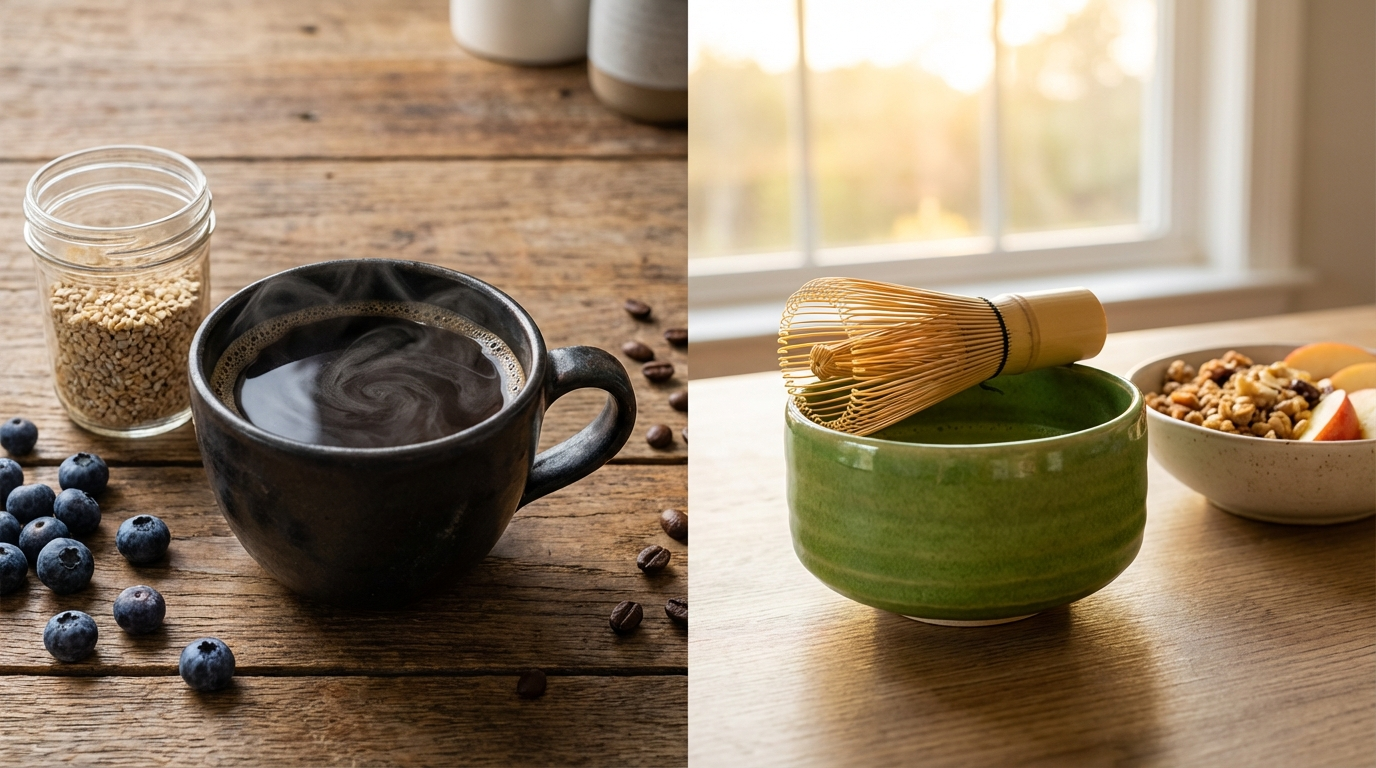
There is a reason this debate never dies: both matcha and coffee can improve alertness, mood, and performance when used strategically. But they do not feel the same, and that matters for your morning ritual. Coffee usually delivers a faster and stronger caffeine hit. Matcha often feels smoother because it pairs caffeine with L-theanine, an amino acid that can reduce perceived stress and improve attention quality.
The question is not “which drink is objectively superior?” The better question is: which drink matches your nervous system, work demands, and cortisol timing in the first 3 hours after waking?
First: What Cortisol Actually Does in the Morning
Cortisol is not the villain social media makes it out to be. It follows a natural daily rhythm and rises sharply after waking, a pattern called the cortisol awakening response. In healthy adults, this morning rise helps mobilize energy, increase vigilance, and prepare the body for daytime demands. Chronobiology research has shown that this response is a normal feature of the stress hormone rhythm, not a pathology to “hack away.”
So should you avoid caffeine during the cortisol rise? The evidence is mixed and more nuanced than most headlines. Some people feel better delaying caffeine 60–90 minutes after waking, especially if they are anxiety-prone or sleep-restricted. Others tolerate immediate caffeine just fine. The practical takeaway: timing is an individual lever, not a universal rule.
Caffeine Kinetics: Why Coffee Hits Harder Than Matcha
Most brewed coffee servings contain roughly 80–120 mg caffeine per cup (sometimes much more), while matcha commonly lands around 38–90 mg depending on grade and preparation. Caffeine itself has a long half-life in adults—often around 5 hours, with large individual variation driven by genetics, liver enzyme activity, medications, and smoking status.
That means your 7:30 AM coffee can still be biologically active at noon, and in sensitive people, can impair sleep when consumed too late in the day. Controlled sleep studies have shown that caffeine consumed even 6 hours before bedtime can significantly reduce sleep duration and quality. Poor sleep then raises next-day caffeine need, and the loop continues.
Matcha is not caffeine-free, but users often report less of a spike-crash profile. Part of this is simply dose. Part is likely matrix effects from tea compounds, including catechins and L-theanine, which may change subjective stimulation quality.
The L-Theanine Factor (Why Matcha Often Feels “Calm Focused”)
L-theanine has been studied for stress reduction and attention modulation. Trials and meta-analyses suggest it can reduce acute stress responses in some contexts and may improve selective attention, especially when combined with caffeine. In plain language: caffeine gives energy; theanine may smooth the edges.
This pairing is the strongest science-based argument for matcha in the morning: not that it boosts energy more than coffee, but that it can produce a steadier mental state for deep work, writing, meetings, and strategic thinking—particularly in people who get jittery from coffee.
Performance Outcomes: Coffee Still Wins for Peak Stimulation
If your goal is maximal acute performance (hard training, reaction speed, short-term output), coffee usually has an edge because caffeine dose is higher and delivery is faster. Sports and cognitive performance literature consistently shows caffeine can improve endurance, vigilance, and perceived effort when appropriately dosed.
But “more stimulation” is not always “better morning.” If your day requires emotional regulation, long concentration blocks, and fewer anxiety spikes, a lower-dose matcha protocol can outperform coffee functionally, even when objective stimulation is lower.
Morning Decision Framework: Choose by Nervous System Type
Use this simple framework:
- Choose coffee first if you sleep well, tolerate caffeine, and need immediate high output.
- Choose matcha first if coffee causes shakiness, rumination, GI upset, or late-day crashes.
- Choose hybrid (small coffee + matcha later) if you want fast activation plus stable midday focus.
A useful protocol for many people is: hydrate on waking, get light movement or daylight, then take caffeine after 45–90 minutes. Start with lower dose than you think you need. Most people are over-caffeinated, under-slept, and misreading withdrawal relief as “focus.”
Blood Sugar and Appetite: Why Pairing Matters More Than Beverage Choice
Whether you choose coffee or matcha, drinking caffeine on an empty stomach can feel rough for some people. You may experience palpitations, nausea, or appetite dysregulation. If that is you, pair your drink with protein and fiber. This blunts perceived stimulation spikes and stabilizes energy. Coffee plus zero calories is not a moral achievement; it is often just a setup for a 10:30 AM crash.
Practical 14-Day Experiment (Use Data, Not Vibes)
Try this A/B test:
- Week 1 (Coffee protocol): 1 cup coffee 60 minutes after waking. No caffeine after 1 PM.
- Week 2 (Matcha protocol): 1–2 tsp matcha prepared traditionally, same timing and cutoff.
- Track daily: morning focus (1–10), anxiety/jitters (1–10), afternoon crash (1–10), sleep latency, total sleep quality.
At the end, compare averages. The better drink is the one that improves whole-day performance, not just your first 90 minutes.
Common Mistakes That Ruin Both Coffee and Matcha Rituals
- Oversized doses: A giant coffee plus energy drink is not productivity—it is chemistry debt.
- Late caffeine: Afternoon intake quietly steals nighttime recovery.
- No hydration: Morning dehydration can amplify fatigue and headaches.
- Poor sleep hygiene: No beverage can compensate for chronic sleep restriction.
- Inconsistent timing: Random caffeine schedules produce random outcomes.
Watch: Evidence-Based Matcha vs Coffee Breakdown
This recent discussion from ZOE features Prof. Tim Spector and walks through nutrition and caffeine tradeoffs in a practical way:
Bottom Line
If you want maximum stimulation, coffee is usually the stronger tool. If you want stable, calm focus, matcha often wins because of lower caffeine load plus L-theanine. For many people, the best protocol is not ideological—it is tactical: right dose, right timing, right cutoff.
Morning rituals work when they reduce friction and improve repeatable performance. Pick the drink that helps you think clearly at 9 AM and sleep deeply at 10 PM. That is the real metric.
Recommended Products on Amazon
Want to make this ritual easier to stick with? These product searches are a good place to start:
References
- Pruessner JC et al. Two formulas for computation of the area under the curve represent measures of total hormone concentration versus time-dependent change. Psychoneuroendocrinology (context for cortisol dynamics).
- Fries E et al. A new view on hypocortisolism. Psychoneuroendocrinology (cortisol rhythm background).
- U.S. FDA. Spilling the Beans: How Much Caffeine is Too Much? (adult intake guidance).
- Drake C et al. Caffeine effects on sleep taken 0, 3, or 6 hours before bedtime. J Clin Sleep Med, 2013.
- Haskell CF et al. The effects of L-theanine, caffeine and their combination on cognition and mood. Biol Psychol.
- Einöther SJL, Martens V. Acute effects of tea consumption on attention and mood. Nutr Rev.
- Guest NS et al. International society of sports nutrition position stand: caffeine and exercise performance. J Int Soc Sports Nutr.
- ZOE YouTube. “Matcha, coffee and green tea: which is healthiest?” (10 months ago): https://www.youtube.com/watch?v=GSWEpAH1oI4
This post contains affiliate links. If you purchase through our links, we may earn a small commission at no extra cost to you.