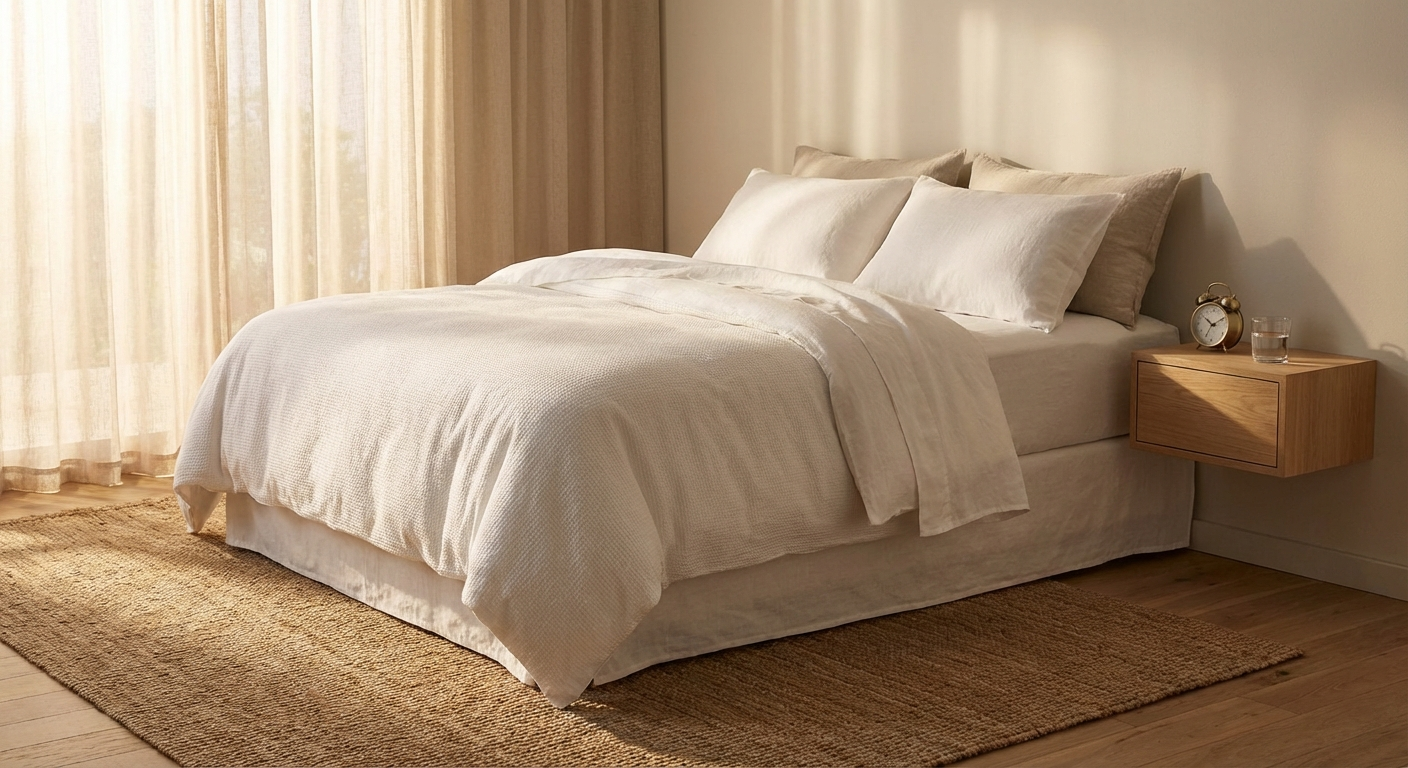
“Make your bed” sounds like old-school advice. For a lot of people, it also sounds trivial: Why spend two minutes pulling sheets tight when you’re just going to mess them up tonight?
Fair question. But behavioral psychology has a useful answer: small actions can shape identity, environment, and decision quality. Making your bed is less about linen aesthetics and more about giving your brain an early cue that the day has started and that you are a person who follows through.
In this guide, we’ll look at the science behind that claim, where the benefits are real (and where they’re overhyped), and how to build a practical bed-making ritual that actually sticks.
Why this habit works: three mechanisms backed by research
1) It creates an immediate “completed task” signal. Human motivation responds strongly to visible progress. Behavioral science consistently shows that small wins increase the likelihood of taking the next action. Teresa Amabile and Steven Kramer’s work on the “progress principle” found that perceived progress in meaningful tasks boosts positive emotion and motivation, even when the progress is small.
Making your bed gives you an immediate completion event. You woke up, you executed a task, and your environment now reflects that. That tiny success can reduce morning drift and make it easier to transition into showering, breakfast, planning, or focused work.
2) It reduces visual clutter, which can lower cognitive load. Clutter doesn’t just look messy; it competes for attention. Studies from attention and environmental psychology show that disorganized spaces can increase mental fatigue and reduce perceived control. When your bedroom starts the day visually “resolved,” your brain has fewer loose visual cues nagging for attention.
This matters most if you work from home, if your bedroom doubles as a workspace, or if you tend to re-enter your room during the day. A made bed acts like a visual anchor: one part of your world is already in order.
3) It reinforces identity-based habits. Behavior-change research (including implementation intention and identity-based framing) suggests habits stick better when they’re connected to identity, not willpower. “I make my bed” becomes shorthand for “I start on purpose.” The ritual is simple enough to repeat daily, which makes it excellent identity training.
Think of it this way: if your first behavior each morning is intentional, your next behavior is more likely to be intentional too. You’re not chasing perfection—you’re training consistency.
What making your bed does not do
Let’s keep this grounded. Making your bed will not cure anxiety, erase burnout, or replace sleep, movement, nutrition, therapy, or medical care. If your mornings are wrecked by chronic sleep deprivation, untreated depression, or a crushing schedule, this habit alone won’t solve the root problem.
But as a keystone cue—a small behavior that nudges better follow-up behaviors—it can be powerful. The gain is not in the blanket. The gain is in your behavioral trajectory from 6:30 AM to 9:00 AM.
The 2-minute protocol (actually realistic)
Use this exact sequence for one week:
- Stand up fully first. Feet on floor, blinds open, one deep breath.
- Pull duvet/comforter to headboard. Don’t aim for hotel-perfect.
- Smooth once on each side. Fast, not fussy.
- Set one “next action” cue. Example: water bottle on desk, gym clothes out, notebook open.
Total time: 90–120 seconds. The key is pairing completion with the next action so momentum continues.
Common mistakes that kill the habit
Mistake 1: perfectionism. If you expect military corners every day, you’ll skip it when time is tight. Aim for “visibly made,” not “magazine shoot.”
Mistake 2: deciding every morning. Decision fatigue starts early. Remove choice: “After I stand up, I make the bed.”
Mistake 3: no environmental support. Tangled sheets and sliding corners make the ritual annoying. Fix friction with better bedding setup.
Mistake 4: trying to stack 10 habits at once. One reliable win beats ten abandoned goals.
Product picks that make this ritual easier
Good tools reduce friction. You don’t need all of these, but each can make the habit easier to keep:
Mellanni Queen Sheet Set
Smooth, easy-care sheets make morning bed reset faster and cleaner.
View on AmazonSheet Straps / Sheet Fasteners
Keeps corners from popping off so your bed takes seconds—not a wrestling match.
View on AmazonPhilips SmartSleep Wake-Up Light
Gentle light alarm makes wake-up less abrupt, which improves compliance with your first habit.
View on AmazonA 7-day experiment to prove it to yourself
Don’t rely on hype. Run a simple test:
- Days 1–7: make your bed within 5 minutes of waking.
- Track 3 metrics (1–10 scale): morning focus, mood by noon, and completion of your first planned task.
- At the end: compare with your usual baseline week.
If your scores don’t improve, drop the habit. If they improve even slightly, keep it as your anchor and build from there.
Video breakdown: a modern, science-backed morning routine
If you want a visual walkthrough of high-leverage morning habits (including the idea of early wins), this recent video is a solid starting point:
The bottom line
Making your bed is not about discipline theater. It’s a low-cost behavioral lever:
- It gives your brain an early completion signal.
- It reduces visual noise and decision drag.
- It reinforces an identity of follow-through.
For most people, the win is subtle but real. A cleaner start often becomes a cleaner sequence of choices.
If you want a practical morning routine that lasts, start with one behavior you can execute every day in under two minutes. For many people, the bed is the easiest place to begin.
Quick FAQ
Should I make my bed immediately after waking? Usually yes, but if you run hot at night, let your bed air out for a few minutes first. Open the covers, brush your teeth, then make it before leaving the room.
What if I live with kids or a partner? Keep standards simple and shared: “flat and tidy” is enough. The goal is consistency, not perfection.
Can this help with procrastination? It can help at the margin by creating early task completion momentum. Pair bed-making with one high-value next action (calendar review, 10-minute walk, protein-first breakfast) for stronger results.
What if I miss a day? Don’t restart a whole plan. Just resume the next morning. Habit strength comes from repetition over time, not an unbroken streak.
References
Amabile TM, Kramer SJ. The Progress Principle. Harvard Business Review Press, 2011.
Vohs KD et al. Physical order produces healthy choices, generosity, and conventionality, whereas disorder produces creativity. Psychological Science. 2013.
Gollwitzer PM. Implementation intentions: Strong effects of simple plans. American Psychologist. 1999.
Lally P et al. How are habits formed: Modelling habit formation in the real world. European Journal of Social Psychology. 2010.
This post contains affiliate links. If you purchase through our links, we may earn a small commission at no extra cost to you.