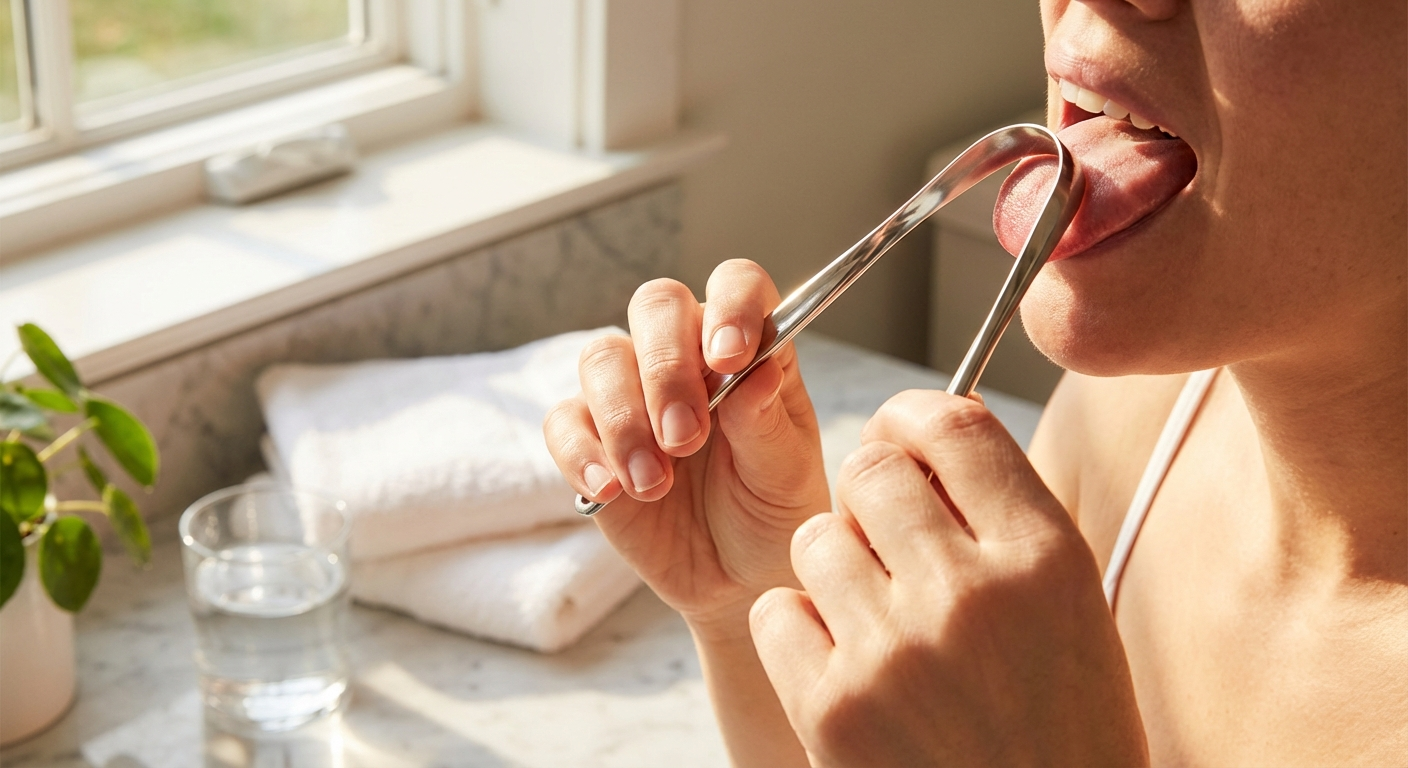
Your tongue is a bacteria magnet. Over the 7–8 hours you sleep, your mouth becomes a breeding ground for anaerobic organisms—the kind that produce volatile sulfur compounds (VSCs) responsible for that unmistakable morning breath. While most people reach for a toothbrush, they're missing a critical step: cleaning the one part of their mouth where bacteria thrive most.
Enter tongue scraping—a 3,000-year-old Ayurvedic practice that's recently caught the attention of modern dentistry. In just 60 seconds, before you brush your teeth, a simple metal or plastic scraper removes a significant portion of the bacterial load that brushing alone can't reach. The result? Fresher breath, cleaner taste buds, and—if you dig deeper into the Ayurvedic tradition—better digestive function and oral health for the entire day.
Why Your Tongue Becomes a Bacterial Hotbed Overnight
Your mouth is a complex ecosystem. Unlike your skin, which sheds dead cells constantly, your mouth maintains a stable environment where bacteria thrive. When you sleep, salivary flow drops dramatically. Saliva—your mouth's natural defense system—stops flowing, and bacteria begin their nighttime party.
The tongue's surface is covered in papillae (tiny bumps) that create a perfect hiding place for bacteria. Over 200 bacterial species live in your mouth at any given time. During sleep, oral bacteria multiply exponentially, settling particularly on the tongue's back and center where anaerobic (oxygen-free) conditions are ideal. These bacteria—*Fusobacterium nucleatum*, *Porphyromonas gingivalis*, and others—break down amino acids and produce hydrogen sulfide and methyl mercaptan: the chemicals responsible for bad breath.
Brushing your teeth does nothing to address this. A standard toothbrush bristle is too soft and fine to mechanically dislodge the bacterial film (biofilm) that coats your tongue. This is where scraping comes in.
The Science Behind Tongue Scraping's Effectiveness
Modern dentistry has now validated what Ayurvedic practitioners knew for millennia: tongue scraping works. A 2020 clinical study published in the *Journal of Ayurveda and Integrative Medicine* found that twice-daily tongue scraping reduced volatile sulfur compounds (the chemicals that cause bad breath) more effectively than brushing alone. Participants who scraped twice daily reduced their VSC levels by approximately 40% more than the control group.
Another study in the *Journal of Oral Microbiology* demonstrated that dedicated tongue scrapers—specifically U-shaped metal tools—removed significantly more bacterial cells from the tongue surface than toothbrushes. The reason is physics: a scraper applies pressure across a wider surface area, physically lifting the biofilm away from the tongue's papillae.
The benefits stack up quickly:
- Immediate fresh breath. Removing VSC-producing bacteria eliminates the source of bad breath within minutes.
- Enhanced taste perception. A clean tongue means dead cells and bacterial debris no longer coat your taste buds. You literally taste food better.
- Reduced cavity risk. Fewer bacteria on the tongue means fewer *Streptococcus mutans* cells—the primary cavity-causing bacteria—migrating to your teeth and gums throughout the day.
- Lower gingivitis and periodontitis risk. By scraping daily, you prevent bacterial buildup that would otherwise spread to your gums, reducing inflammation and gum disease risk.
- Stimulated saliva production. The gentle scraping action triggers mechanoreceptors on your tongue, signaling your salivary glands to increase flow. More saliva = more natural antibacterial protection all day.
The Ayurvedic Angle: Tongue Scraping and Digestion
Modern dentistry focuses on oral bacteria. Ayurveda takes a different, more systemic view. In Ayurvedic medicine, your tongue is a diagnostic tool—different regions of the tongue correspond to different organs. Your tongue's center connects to your digestive system. When you sleep lying down horizontally, metabolic waste accumulates on your tongue (called "ama" in Ayurvedic terminology—basically undigested toxins and metabolic byproducts).
Scraping first thing in the morning, before eating or drinking, removes this overnight accumulation. According to Ayurvedic theory (and increasingly supported by modern research), this signals your digestive system to "wake up." Your tongue's nerve endings are directly wired to your vagus nerve, which controls parasympathetic digestion. A gentle morning scrape may activate better digestive enzyme production and gastric juice secretion—priming your body for better food digestion throughout the day.
While the organ-mapping aspect of Ayurveda remains spiritual and philosophical, the practical result is measurable: people who scrape their tongues in the morning report improved digestion and less bloating. Whether it's pure neurological signaling or true organ-system effects, the outcome is the same.
How to Scrape Your Tongue Like a Pro
Tongue scraping is deceptively simple—but technique matters. Here's how to do it correctly:
- Pick the right tool. Use a dedicated tongue scraper (copper, stainless steel, or plastic). Copper is traditional; stainless steel is hygienic and durable; plastic is budget-friendly. Avoid using your toothbrush—the bristles won't generate enough pressure.
- Scrape first thing, before brushing. Do this immediately after waking, before eating, drinking, or brushing. Your tongue's biofilm is thickest and easiest to remove now.
- Stick out your tongue and look up. This flattens your tongue and reduces gagging. Breathe through your nose—it steadies your mind.
- Hold the scraper at a 45-degree angle to your tongue's surface. Too steep and you'll scrape too hard; too shallow and you won't remove anything.
- Gently pull from back to front (throat toward the tip). Make 5–10 long, smooth strokes. Repeat 3–4 times if needed. You'll see a white or yellowish film on the scraper—that's the biofilm you're removing.
- Rinse your mouth and the scraper. Flush out any loose debris.
- Don't scrape too hard. Your tongue is delicate. You're aiming for gentle pressure, not aggressive scrubbing. Excessive force can irritate the tongue's surface.
The entire process takes 60 seconds. By the time you brush your teeth, your tongue is already bacteria-free, and your mouth is primed for better oral hygiene for the rest of the day.
The Microbiome Trade-Off: What You Should Know
Like any intervention, tongue scraping has a nuance worth understanding. While scraping reduces harmful bacteria, it also temporarily reduces your oral microbiome's overall diversity. Your mouth contains both beneficial and harmful bacteria; scraping removes both indiscriminately.
In the long term, your microbiome rebounds and rebalances. The question is: does this temporary reduction cause problems? The evidence suggests no. In fact, reducing your daily bacterial load—especially anaerobic VSC-producing species—appears to tip the microbiome balance toward healthier organisms. Your mouth's natural defenses (saliva, immune cells, beneficial bacteria) quickly restore balance within hours.
The only exception is if you scrape excessively or too aggressively, which could irritate your tongue and disrupt its protective mucous layer. Stick to once daily (morning) or twice daily (morning and evening) with gentle pressure, and you'll avoid any issues.
Why This Matters for Your Morning Routine
Tongue scraping fits perfectly into a structured morning ritual. It's a natural gateway to better oral health: scrape → stimulate saliva → brush → floss → rinse. The order matters because scraping primes your mouth for deeper cleaning.
More importantly, it's a tangible, sensory act. Unlike vitamins or supplements (which disappear silently into your body), scraping gives you immediate feedback: you see the biofilm on the scraper, you taste the difference immediately, and you feel your tongue's texture change. This sensory feedback triggers a psychological shift—you feel like you've actually *done* something for your health, which builds motivation for the rest of your morning routine.
Stainless Steel Tongue Scraper
A durable, hygienic tongue scraper with the right angle and pressure for effective biofilm removal. Many come with a storage case for travel.
Budget: $15–25. Lasts 5+ years with proper care.
The Bottom Line
Tongue scraping isn't trendy. It's not new. It's a 3,000-year-old practice that dentists are only now taking seriously—and the science backs it up. In 60 seconds, you can eliminate the bacterial biofilm that causes 90% of morning breath, improve your taste perception, and give your digestive system a gentle "good morning" signal.
If you're serious about morning rituals and oral health, tongue scraping is non-negotiable. It's cheap, it takes less time than brushing, and the results are immediate and measurable.
Start tomorrow morning. You'll notice the difference by the afternoon.
Recommended Products on Amazon
Want to make this ritual easier to stick with? These product searches are a good place to start:
This post contains affiliate links. If you purchase through our links, we may earn a small commission at no extra cost to you.