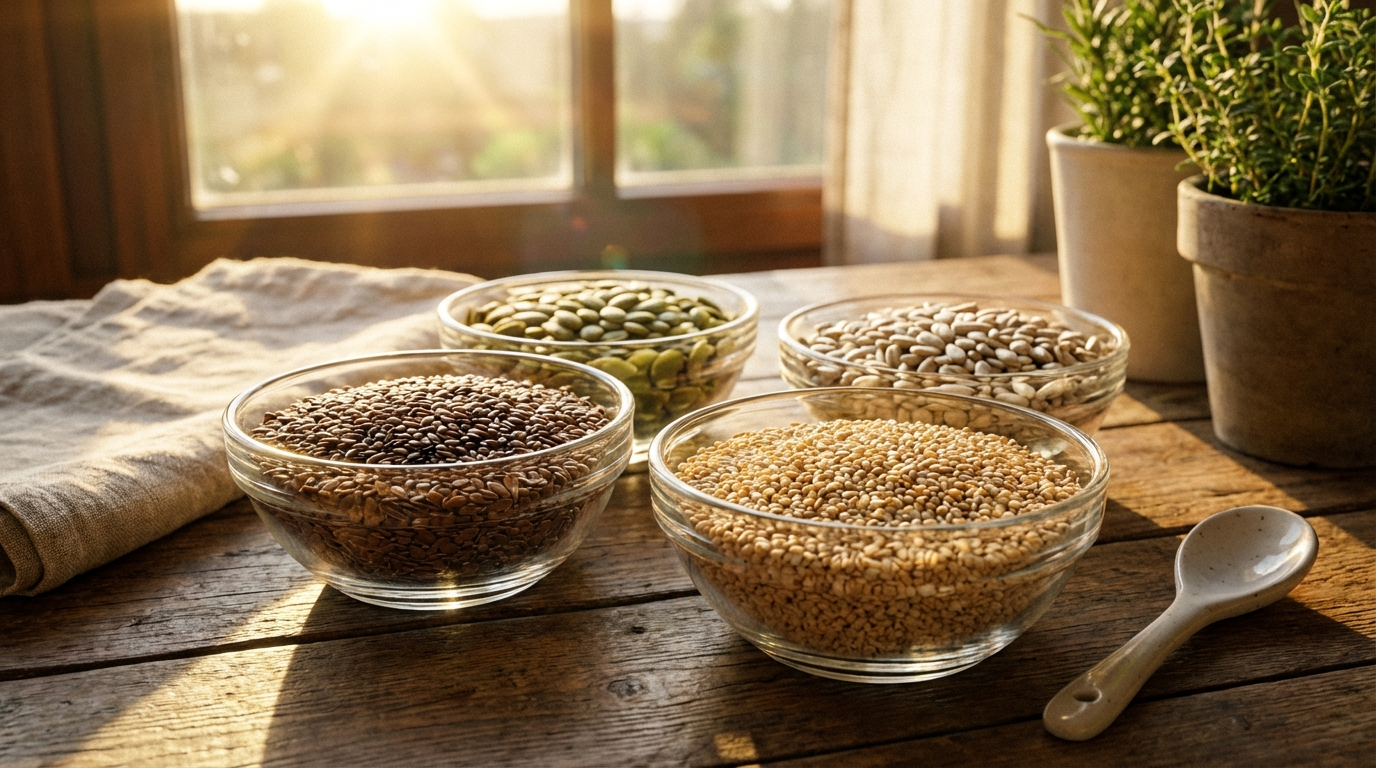
If you've ever felt like your energy, mood, and body are on a monthly rollercoaster, you're not alone. Hormonal fluctuations affect everything from sleep quality to focus to how you feel in your own skin. And while you can't stop your cycle, there's a simple morning ritual that can help bring your hormones into better balance: seed cycling.
It sounds almost too simple—sprinkling four different types of seeds into your breakfast at different times of the month. But the science behind it is solid, and women across the world are reporting real results: better sleep, clearer skin, less PMS, improved fertility, and more stable energy.
What Is Seed Cycling?
Seed cycling is a nutritional practice where you rotate specific seeds throughout your menstrual cycle to support the natural production and metabolism of your two main reproductive hormones: estrogen and progesterone.
The practice is based on a simple principle: different nutrients support hormone production during different phases of your cycle. By timing when you eat certain seeds, you're essentially giving your body exactly what it needs, exactly when it needs it.
Dr. Jolene Brighten, a functional medicine naturopathic doctor and hormone specialist, popularized seed cycling in her work with patients struggling with PMS, irregular periods, acne, and hormone imbalances. She discovered that this food-based approach—no pills, no hormones—worked just as well as pharmaceutical interventions for many women, with zero side effects.
The Two Phases: What Seeds to Eat and When
Phase 1: Follicular Phase (Days 1-14)
This phase begins on the first day of your period and runs until ovulation. During this time, your body is ramping up estrogen production. Eat flax seeds and pumpkin seeds.
- Flax seeds (1 tablespoon per day): Rich in lignans, which help your liver process excess estrogen. They're also packed with omega-3 fatty acids and fiber, which reduce inflammation and support healthy hormone detoxification.
- Pumpkin seeds (1 tablespoon per day): Loaded with zinc and magnesium, which are essential for hormone production during this phase. Zinc also supports the production of serotonin and melatonin—two neurotransmitters that improve mood and sleep.
The result? Better hormone production, clearer skin, better mood, and more energy going into ovulation.
Phase 2: Luteal Phase (Days 15-28)
After ovulation, your body shifts its focus to supporting progesterone production. This is when you switch to sunflower seeds and sesame seeds.
- Sunflower seeds (1 tablespoon per day): High in vitamin E and selenium. These nutrients reduce inflammation, ease period cramps, and support progesterone production—all critical as you head toward your period.
- Sesame seeds (1 tablespoon per day): Contain lignans and phytoestrogens that help bind excess estrogen in your gut, making room for progesterone to do its job. They're also mineral-rich, supporting hormonal stability.
When these nutrients are present in the luteal phase, women report less PMS, fewer mood swings, better sleep, and reduced bloating.
How to Start Seed Cycling This Morning
The beauty of seed cycling is that it's dead simple. Here's how to build it into your morning ritual:
Step 1: Buy Fresh, Raw Seeds
Visit your local health food store or order online. Get organic, raw (not roasted) seeds. Quality matters because you want maximum nutrient content. Store them in the fridge in glass containers—they oxidize quickly once opened.
Step 2: Grind Them Fresh
This is the key step many people skip, but it's crucial: grind your seeds fresh each morning (or at least fresh each day). Whole seeds pass through your digestive system mostly unabsorbed. Ground seeds release all their nutrients—lignans, minerals, and healthy fats—making them bioavailable to your body.
Use a cheap coffee grinder or high-powered blender. Takes 30 seconds.
Step 3: Add to Your Breakfast
Now for the fun part. Sprinkle your ground seeds into:
- Smoothie bowls (acai bowls with berries are perfect)
- Greek yogurt with honey and berries
- Oatmeal or granola
- Smoothies (blend them in)
- Salads (works with lunch too)
- Chia pudding overnight
Pro tip: Use about 1 tablespoon of each seed per day (so 2 tablespoons total per morning). Consistent, daily use is what produces results.
What Results Can You Actually Expect?
Research on seed cycling is still emerging, but functional medicine practitioners and their patients have documented consistent results:
- Better periods: More regular cycles, predictable flow, less cramping
- Less PMS: Reduced breast tenderness, bloating, mood swings, and fatigue
- Clearer skin: Hormonal acne diminishes as estrogen and progesterone stabilize
- Better sleep: Especially in the luteal phase, when progesterone naturally supports deeper sleep
- More stable mood: Less emotional turbulence across your cycle
- Improved fertility: Many women report more predictable ovulation and easier conception
- Consistent energy: No more dramatic crashes in the luteal phase
Most women notice changes within 1-3 months of consistent daily use. Your hormones take time to recalibrate, so patience is part of the protocol.
What If You Don't Menstruate?
Seed cycling isn't just for people with traditional cycles. If you're perimenopausal, menopausal, postpartum, on hormonal birth control, or have irregular periods, you can still benefit:
- Use a lunar cycle instead: Follow the new moon to full moon (days 1-14) using follicular seeds, then full moon to new moon (days 15-28) using luteal seeds.
- Use a 14-day rotation: Two weeks of follicular seeds, two weeks of luteal seeds, repeat.
- Continue lifelong: Women in perimenopause, menopause, and beyond still produce hormones. Seed cycling continues to support healthy hormone levels, bone density, and mood stability.
The Science Behind It
While large clinical trials on seed cycling are limited, the individual components are well-studied:
- Lignans (in flax and sesame) are phytoestrogens that bind to excess estrogen in your gut, preventing reabsorption and supporting healthy detoxification through the liver.
- Zinc and magnesium (pumpkin seeds) are essential cofactors in the production of progesterone and other reproductive hormones.
- Selenium and vitamin E (sunflower and sesame seeds) are powerful antioxidants that reduce inflammation, particularly valuable during the luteal phase when inflammation naturally rises.
- Omega-3 fatty acids (flax seeds) support hormone receptor sensitivity, meaning your cells respond better to the hormones your body produces.
The timing-based approach leverages something called the two-cell, two-gonadotropin model—the idea that your ovaries need different micronutrients at different phases of your cycle. Seed cycling is essentially nutritional support for that natural rhythm.
Making It a Daily Habit
The best health ritual is the one you actually stick with. Here's how to make seed cycling automatic:
- Pair it with something you already do: Add seeds to the breakfast you're already eating. No new meal to prepare.
- Set a calendar reminder: When your period starts, set a phone reminder that switches every 14 days. Some women color-code: red marker on their calendar for follicular seeds, blue for luteal.
- Prep seeds weekly: On Sunday, grind a week's worth of seeds (keep them in the fridge in separate jars) so you just grab a jar each morning.
- Track results: Keep a simple log of your mood, energy, skin, and period symptoms. After 2-3 months, you'll see the pattern.
One Simple Morning Ritual, Real Results
Seed cycling isn't a miracle cure, and it's not a replacement for medical care if you have serious hormonal conditions. But for women looking for a natural, evidence-informed way to support their bodies during different phases of their cycle, it's one of the most cost-effective and accessible tools available.
It takes less than a minute each morning. Four seeds. That's it.
By the time you finish reading this article, you could be on your way to more stable hormones, better sleep, clearer skin, and more predictable mood. Isn't that worth trying?
Learn More: Dr. Jolene Brighten on Seed Cycling
Dr. Jolene Brighten explains the science and practical steps for seed cycling in this detailed video from her YouTube channel.
Recommended Products on Amazon
Want to make this ritual easier to stick with? These product searches are a good place to start:
This post contains affiliate links. If you purchase through our links, we may earn a small commission at no extra cost to you.