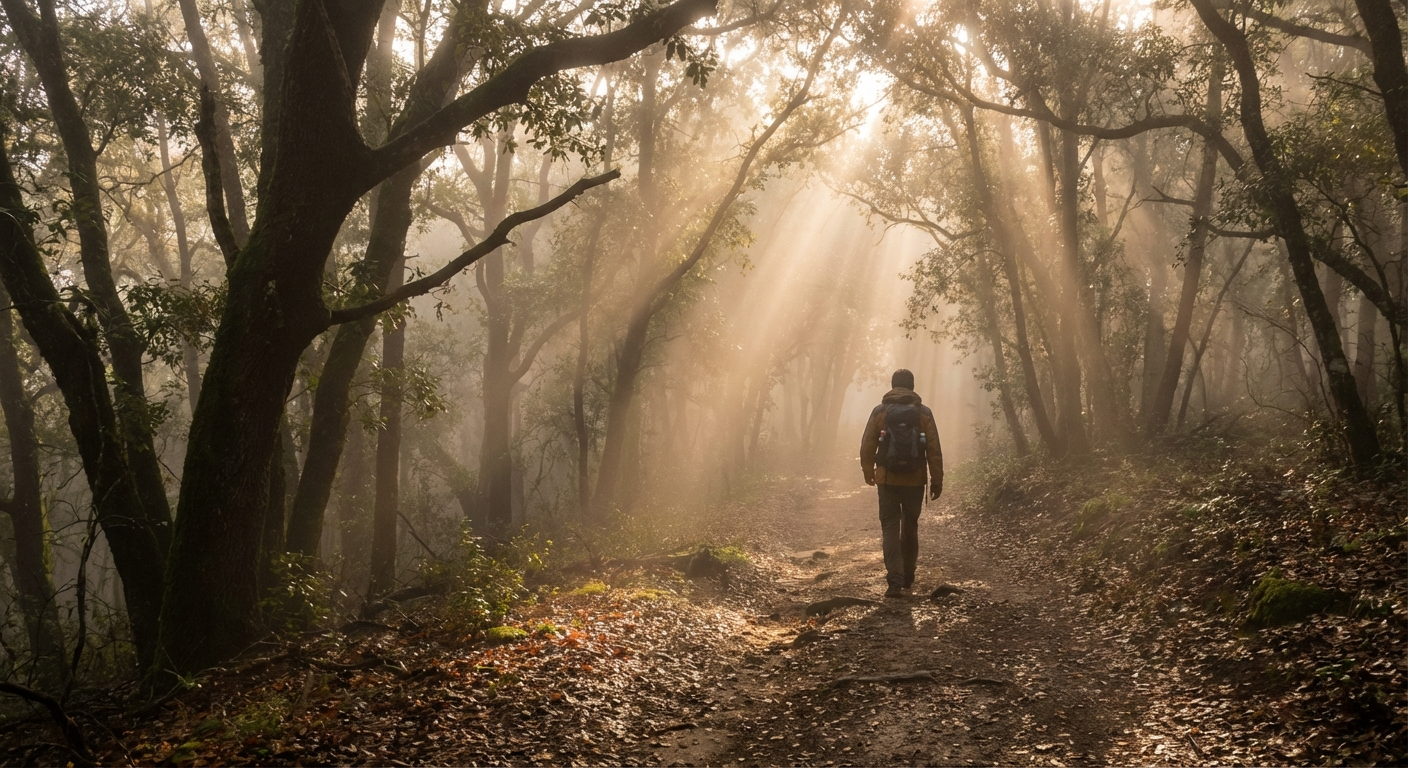
There is a moment between sunrise and 8 AM when the world is different. The light is softer and more horizontal. The air is cleaner. The noise is lower. The demands haven't started yet. And your brain—still emerging from sleep mode—is in a uniquely receptive state that researchers are only now beginning to fully understand.
A morning walk in this window isn't exercise in the conventional sense. It doesn't build significant cardiovascular fitness or torch calories. What it does do is something more fundamental: it synchronizes your biology with the planet's light cycle, triggers a cascade of neurochemical events that determine your mood and focus for the next 12 hours, and activates the specific neural circuits that drive creative insight and problem-solving.
The research is unambiguous. Stanford. Harvard. The National Institute of Mental Health. All pointing in the same direction: the morning walk is one of the highest-leverage investments you can make in your cognitive and emotional health. And it costs nothing.
The Light-Dopamine Connection: What Dawn Does to Your Brain
When morning light hits your eyes, it doesn't just help you see. It activates a specialized pathway involving intrinsically photosensitive retinal ganglion cells (ipRGCs)—light-sensitive cells in your retina that connect directly to your suprachiasmatic nucleus (SCN), the master clock of your circadian system.
This signal does several things simultaneously:
Cortisol Awakening Response (CAR) Calibration
Your cortisol naturally peaks 30-45 minutes after waking—this is the cortisol awakening response, and it's supposed to happen. Morning light exposure confirms to your brain that "morning has arrived," amplifying and timing this cortisol pulse precisely. A well-timed CAR gives you sharp alertness, clear thinking, and strong motivation in the morning hours. Poor light exposure (rolling out of bed into a dark apartment) blunts the CAR, leaving you sluggish until mid-morning. Morning light walks literally calibrate your morning alertness curve.
Serotonin Synthesis
Bright light—especially the broad-spectrum, low-angle light of early morning—triggers serotonin synthesis in the raphe nuclei of your brainstem. Serotonin is your "steady, content, capable" neurotransmitter. It supports mood stability, impulse control, and the feeling that things are going to be okay. Morning light is one of the most potent natural serotonin activators available. This is why light therapy works for seasonal depression (SAD)—and why a morning walk outside outperforms any light therapy lamp.
Dopamine System Priming
Dr. Andrew Huberman's research at Stanford has brought mainstream attention to what circadian biologists have known for years: morning light exposure activates a dopaminergic pathway that primes motivation circuits for the day. Walking in morning light doesn't just give you dopamine—it "loads" your dopamine system for the hours ahead, enhancing your capacity for drive, focus, and reward-seeking throughout the morning work session. This is categorically different from coffee, which spikes adenosine blocking and drops, leaving the underlying system unchanged.
The Walking Component: Bilateral Stimulation and the Creative Brain
Light explains the neurochemical effects. But walking itself does something distinct: it stimulates bilateral, cross-body movement—left leg, right arm; right leg, left arm—that triggers cross-hemispheric brain communication. This rhythmic, bilateral activation is used therapeutically in EMDR (Eye Movement Desensitization and Reprocessing) to process stored trauma, and researchers have tracked similar effects in regular walking.
The Stanford Creativity Study
In a landmark 2014 Stanford study, participants completed divergent thinking tasks (a standard measure of creative thinking) while seated, then while walking—either on a treadmill facing a blank wall or walking outside. Walking outside produced an 81% increase in divergent thinking scores compared to sitting. Treadmill walking (with no visual stimulation) produced a 60% increase. The study authors concluded that walking itself—not scenery—drives the creative boost, though environmental novelty amplifies it further.
Default Mode Network Activation
When you walk without a phone, your brain enters the default mode network (DMN)—the neural network active during mind-wandering, daydreaming, and self-reflection. The DMN is where your brain integrates experiences, consolidates memories, and generates novel connections. It's where your best ideas come from. Constant screen stimulation suppresses the DMN. A 20-minute phone-free morning walk gives your DMN a dedicated activation window each day—which is why writers, scientists, and executives consistently report that their best ideas arrive during morning walks.
Hippocampal Neurogenesis
Aerobic exercise—even low-intensity walking—triggers BDNF (brain-derived neurotrophic factor), a protein often called "Miracle-Gro for the brain." BDNF promotes hippocampal neurogenesis (new neuron growth in your memory and learning center) and strengthens synaptic connections. Morning is the optimal time for this effect because cortisol and BDNF interact synergistically. Studies in both rodents and humans show that morning exercise produces greater hippocampal growth compared to afternoon or evening exercise at the same intensity.
The 20-Minute Morning Walk Protocol
The research coalesces around a specific set of conditions that maximize the walk's neurological benefits. Here's the protocol:
Timing: Within 60 minutes of waking, ideally at or just after sunrise.
The circadian light-entraining signal is most potent in the first 60 minutes of waking when cortisol is still rising. Pre-sunrise is less effective (the light is too dim for ipRGC activation). Post-60-minutes still works, but the CAR calibration effect diminishes. Aim for sunrise ±30 minutes.
Duration: 20 minutes minimum.
10 minutes produces partial benefits. 20 minutes delivers the full serotonin synthesis effect and provides enough bilateral stimulation for meaningful DMN activation. 30-45 minutes is ideal if schedule permits, but 20 is the minimum effective dose.
Pace: Comfortable, conversational.
You're not training for a race. This is a nervous system regulation and circadian synchronization activity. A pace at which you could hold a conversation—typically 2.5-3.5 mph—is optimal. If you're winded, slow down. The cardiovascular load is not the point.
No sunglasses (if comfortable).
Sunglasses significantly reduce the lux level reaching your retinal ipRGCs—the cells that send the circadian calibration signal. If the light is genuinely bright enough to be uncomfortable, use sunglasses. But for early morning walks when the sun is low, try going without them. You don't need to stare at the sun; ambient outdoor light is sufficient and dramatically higher than indoor lighting.
No phone (or phone-free mode).
Phone scrolling suppresses the DMN and prevents the creative, integrative thinking that makes morning walks so cognitively valuable. If you bring your phone for safety or navigation, put it in a pocket and don't look at it. This is your 20 minutes of unstructured thinking time—guard it.
Route: Varied is better than repetitive.
Novel environments engage your hippocampal place cells and produce more BDNF than familiar routes. If you walk the same block every morning, your brain habituates. Rotate routes, or walk in a direction you don't usually go. Parks, trails, and nature settings also amplify stress reduction via attention restoration theory—the psychological effect of soft fascination that comes from natural environments.
What to Do With Your Mind During the Walk
Nothing planned. That's the answer.
Don't listen to a podcast. Don't dictate emails. Don't mentally rehearse your to-do list. Let your mind wander where it goes. This is the hardest part for high-performers who feel unproductive the moment they're not consuming or producing content. But the mind-wandering IS the output. You're incubating. You're integrating.
Many people find that they return from their morning walk with one clear idea, insight, or decision that had been stuck the night before. This isn't coincidence—it's the default mode network doing what it's designed to do when given space.
One practical tool: keep your phone in your pocket and a small notepad nearby (or use voice notes). When an insight arrives—and it will—capture it in 10 seconds and return to mind-wandering mode. Don't spin out into action planning mid-walk.
The Video: Science of Morning Walks Explained
The neuroscience of morning light and movement goes deeper than this article covers. Here's an excellent deep-dive for those who want the full picture:
Pay particular attention to the discussion of ipRGC activation and the 15-30 minute threshold for meaningful circadian entrainment—this is the science behind why duration matters.
The 30-Day Morning Walk Protocol
Consistency is where the real benefits accumulate. Circadian entrainment strengthens over weeks. Hippocampal neurogenesis accumulates. Mood baseline rises.
Week 1: Establish the anchor. Walk 20 minutes every day. Focus only on showing up—route, pace, and phone habits don't matter yet. Just build the habit anchor.
Week 2: Add the protocol details. No phone. No sunglasses if comfortable. Vary your route at least every other day. Note how you feel on walk days vs. non-walk days.
Week 3: Track the cognitive effects. Keep a simple log: walk time, mood (1-10), creativity/insight score (1-10), energy at noon (1-10). By week 3, patterns become clear. Most people notice that walk days produce measurably better creative output and afternoon energy.
Week 4: Extend to 30 minutes. If schedule allows, push to 30 minutes. The additional 10 minutes amplify the BDNF effect and give more DMN activation time. Notice whether this produces a qualitative difference in the insights arriving post-walk.
Integration Into Your Complete Morning Ritual
The morning walk integrates best after hydration and before the high-focus work window:
6:00 AM — Wake + 16oz water
6:05 AM — Morning walk (20-30 min) — phone in pocket, no sunglasses
6:30 AM — Return, light breakfast or coffee
6:45 AM — Journaling or planning (10 min) — capture walk insights
7:00 AM — High-focus deep work window begins
This sequence times your cortisol peak with your walk, delivers a BDNF and serotonin hit, then flows directly into your high-focus work window when your neurochemistry is optimized. The journaling step serves as a bridge—capturing the walk's insights before the day's demands crowd them out.
A Word on Weather, Seasons, and Excuses
Cold weather doesn't reduce the circadian benefits of morning light—only indoor artificial light does. A walk in overcast winter conditions delivers 10,000-20,000 lux (a cloudy outdoor morning), compared to typical indoor lighting at 200-500 lux. Even through cloud cover, outdoor morning light is 10-40x more intense than indoor alternatives.
Rain gear, layers, and a good pair of shoes eliminate nearly every weather objection. The people who walk every morning, regardless of conditions, consistently report the habit as one of their most non-negotiable—precisely because they learned early that weather is an excuse, not a barrier.
The Bottom Line: 20 Minutes That Changes Your Whole Day
The morning walk is the single highest-ROI ritual in this category because it requires no equipment, costs nothing, and delivers benefits that stack: circadian alignment, serotonin and dopamine priming, creative insight generation, hippocampal neurogenesis, and mood baseline elevation. No supplement or device replicates this combination.
The research is consistent: people who walk in morning light report better mood, sharper focus, more creative output, and better sleep quality than matched controls who don't. The effects are observable within 3-5 days and cumulative over months.
Tomorrow morning, set your alarm 25 minutes earlier than usual. Walk outside within an hour of sunrise. Leave your phone in your pocket. Let your mind wander. Come home, pour your coffee, and notice what's different.
The answer will be: almost everything.
Recommended Products on Amazon
Want to make this ritual easier to stick with? These product searches are a good place to start:
This post contains affiliate links. If you purchase through our links, we may earn a small commission at no extra cost to you.